Emblems
Here's the last (and my favorite) article of the Soviet Constitution of 1924:
Article 11:
On the emblem, flag and capital of the Union of Soviet Socialist Republics.
70. The governmental emblem of the Union of Soviet Socialist Republics consists of a sickle and hammer on the sphere of the earth, lit by the rays of the sun and framed with wheat stalks, with the inscription in 6 languages named in statute 34: "Workers of the world, unite!" On top of the emblem is a five pointed star.
71. The governmental flag of the Union of Soviet Socialist Republics consists of red or scarlet cloth, with the image on the top corner near the flagpole of the gold sickle and hammer and under it a red, five-pointed star, framed with gold edging. The ratio of width to height is 1:2.
My question: will I be purged for accidentally dyeing my flag crimson?
Addendum: If you don't think this is funny yet, think about this. I was in the Ryazan Party Archive last year, doing what I usually did--looking through documents in a somewhat random fashion and finding funny shit--when I found the minutes to a conference in 1918 about propaganda for peasants. An important issue, but not pressing for the delegates. Their debate in the first two pages (representing a day) focused on the food and time for lunch during the week-long conference. The latter issue was settled in a 10-5 vote for 2:00pm rather than 4:00pm. When I related this to the university office secretary she laughed at first, but then I told her that the vote meant a difference of two hours and she said, "Oh, well that's a different matter."
Sunday, December 30, 2007

Tuesday, December 11, 2007
Scenes from Rostov


In case you can't make out the figures, this is Karl Marx Square, where I live (That is, for now, I had a fight with my landlord over the consistent absence of water and am moving, unfortunately.) and on the left is a New Year's Tree stand, with Russian Santa, Papa Frost. A little history behind the statue. Before the Revolution the stand held a statue of Catherine the Great. She granted Armenians the right immigrate from Turkey to the area Rostov in a village called Nakhichivan, which eventually was incorporated into the city. After the Revolution you can guess what happened. Anyhow, you can see why I think this is funny.

This is a performance by a group of young supporters of Edinaia Rossia. Their mascot, a man in a polar bear costume, also was present. This performance repeated all across the city (and presumably the country). The music sounded like "The Final Countdown" by Europe, but not as awesome, mainly because the Detroit Pistons' starting lineup couldn’t make it (although Rasheed Wallace reportedly does support Putin's plan). The girl looking at me taking the picture was not, contrary to appearances, questioning the conventional wisdom of the sitting government, but was wondering why I wasn't dancing (she was).
Friday, December 07, 2007
A Naive Spy
So, how does rehabilitation calculus work? In short, I have no idea and probably never will. My guess is that it works a lot like financial aid for grad school in the US, with the Military Prosecutor's office acting as admissions. My first attempt to get in touch with the office was through the military newpaper. Although they wouldn't give me the guy's email address or phone, they did give me his name and their politeness gave me the hope, sweet hope, that he would be willing to answer a few questions.
She got me! Anyway, here's some secret spy shit from Rostov.


I mentioned in a previous post that I'm doing research on political rehabilitations. My plan was to start with newspaper articles and, once I got a feel for how rehabilitations had been handled before, to get an interview with the Military Prosecutor for the Northern Caucus Military District (Военная Прокуратора СКВО).
The papers came up with a few interesting tidbits: in the mid-nineties, a woman received 6.5 million rubles--roughly $1,000 according to the exchange rate in the same newspaper or $2,000 dollars today, after the monetary reforms--for being incarcerated for political crimes under Stalin and another woman received half that amount; yet another was (and perhaps still is) receiving 107 rubles ($4.25) per month as payment for the execution for her father for political crimes. In total, of all petitions for rehabilitation, something like 4 million throughout the country, roughly 20% were rejected.
So, how does rehabilitation calculus work? In short, I have no idea and probably never will. My guess is that it works a lot like financial aid for grad school in the US, with the Military Prosecutor's office acting as admissions. My first attempt to get in touch with the office was through the military newpaper. Although they wouldn't give me the guy's email address or phone, they did give me his name and their politeness gave me the hope, sweet hope, that he would be willing to answer a few questions.
In fact, they had told me to look for him at the office at the military base downtown. My plan was to go down there and ask for an appointment or, even better, be given an audience with the man immediately. After I wrote up a list of questions in case of the latter, I told the people in my office where I was going to their horror. Occording to them, going to this base would probably lead to me being shot, or at least ridiculed. Since I fear humiliation more than death, I decided to head their advice and let my secretary call his secretary and to try to make an appointment.
The following is their conversation, half of which was reported to me:
My Secretary: Hello, can we have Colonel so-and-so's office. This is Southern Federal University.
Their Secretary: What do you want?
MS: An American student wants to set up an appointment to ask about the process of rehabilitations in Russia.
TS: You know that all Americans are spies.
She got me! Anyway, here's some secret spy shit from Rostov.

"The Plumber's Beloved"

"Meat Products"

Monday, December 03, 2007
A Predictable, Clean Finish to a Dirty Race
The parliamentary elections finished without a hitch for Edinaia Rossia, not surprisingly. The communists, who are the largest minority now, and Yabloko, a center-liberal party, have alleged some violations of the elections and have produced a list of fairly detailed complaints. While I have no doubt these things happen, this is energy misplaced. The violations are mostly limited to one or two districts or, at most, a city and are small things, like confusing ballots or voting without registration. These things probably should be investigated, but though a change of several thousand votes may swing a Duma seat from one party to another, it means nothing for the small parties.
Yabloko is grousing up the wrong tree. By and large Edinaia Rossia let the TsIK (Central Election Commission) do its work counting votes and do it openly. (I thought it strange that 99% of Chechnya voted for Edinaia Rossia but this can probably be explained by a combination of fear of the central government, fear of the local leader (a former rebel now Edinaia Rossia's leading candidate in Chechya), respect of the local leader and the fact that current and future government is pumping lots of money into rebuilding Grozny.) So if Yabloko shouldn't complain about the way the elections turned out, what should they complain about?
1. Putin's role in the election: According to the Russian constitution, the President must be party-less. So how can Putin head Edinaia Rossia's candidate list? Other political parties brought this to a judge's attention to no avail; Putin is the top candidate but not officially a member of the party. Okay, but what happens when Putin wins? He simply refuses the office and continues to be president or stops being president to become a Duma representative, much like what would have happened had John Kerry won the presidential election (only the opposite). While this legal decision is understandable, it clearly misinterprets the spirit of the law, which intended for the president to be a mediator between parties rather than a partisan supporter of one or another party.
2. Raising the percentage to enter parliament: This election required a party to receive more than 7% to have any candidate in the Duma; the minimum previously was 5%. The effect of this is two-fold. First, a party like Yabloka is unlikely to get 7% of the vote but could possibly get 5%. Ditto for the Agrarian Party, a former faction of the Communist Party. People who would have supported Yabloko or the Agrarian Party voted for a larger party, primarily Spravedlivaia Rossia (a left-wing pro-Kremlin party) and the Communist Party, respectively. In addition, some people just didn't go to vote at all.
The second effect of this change is that the four parties which enter the Duma will divide up the roughly 10% of seats representing the population that didn't vote for them. By percentages, Edinaia Rossia, the Communists, LDPR (a right-wing nationalist party) and Spravedlivaia Rossia should receive 284, 50, 38 and 36 seats, respectively. As it is, they will receive around 308, 58, 44 and 40, respectively (all the votes are not counted yet so don't quote me on these figures, not official but the best I can do). Had, say, Spravedlivaia Rossia lost 2 percentage points to Yabloko, the approximate distribution of the three remaining parties would be 345, 60, 45, respectively. As such, Edinaia Rossia has really stacked the deck against smaller parties contending for Duma seats and strengthened their own majority by taking the seats that would represent small parties.
On a side note, Yabloko, the Union of Right Forces and Grazhdanskaia Sila are also to blame for their failure in this respect. As the leader of the latter admitted on television last night, the three parties are similar enough that have no reason not to combine into an opposition block. In fact, simply combining their results gives them around 5%, which would have likely inspired and mobilized the non-voting opposition.
3. The removal of the protest vote: Before 2003 Russians could cast a protest vote against all parties. If this option receives a majority, the whole process repeats itself. Hard to imagine this would actually happen but when a large percentage votes against all it at least shows public dissatisfaction. While some of these protest votes may have funneled into, say, Spravedlivaia Rossia, Yabloko, etc., more likely is that these people just stayed home.
4. Edinaia Rossia's use of the media: As I mentioned in previous posts, Edinaia Rossia campaigned in the guise of regular programming, in particular on news programs and "special reports" on protests, while other parties were relegated to late night commercial spots and ridiculous debates. It's hard to compete when the first half of the news covers the campaigns of Edinaia Rossia candidates, followed by sports and the weather.
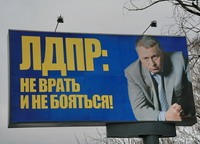
Non-Edinaia Rossia parties are pointing these things out, too, but in a much more muted fashion, while they are putting voting fraud--a relatively minor problem--in the forefront. I can see the same thing happening in the presidential election whenever Putin reveals his preferential successor. Anyway, here's my favorite poster from the election:
The parliamentary elections finished without a hitch for Edinaia Rossia, not surprisingly. The communists, who are the largest minority now, and Yabloko, a center-liberal party, have alleged some violations of the elections and have produced a list of fairly detailed complaints. While I have no doubt these things happen, this is energy misplaced. The violations are mostly limited to one or two districts or, at most, a city and are small things, like confusing ballots or voting without registration. These things probably should be investigated, but though a change of several thousand votes may swing a Duma seat from one party to another, it means nothing for the small parties.
Yabloko is grousing up the wrong tree. By and large Edinaia Rossia let the TsIK (Central Election Commission) do its work counting votes and do it openly. (I thought it strange that 99% of Chechnya voted for Edinaia Rossia but this can probably be explained by a combination of fear of the central government, fear of the local leader (a former rebel now Edinaia Rossia's leading candidate in Chechya), respect of the local leader and the fact that current and future government is pumping lots of money into rebuilding Grozny.) So if Yabloko shouldn't complain about the way the elections turned out, what should they complain about?
1. Putin's role in the election: According to the Russian constitution, the President must be party-less. So how can Putin head Edinaia Rossia's candidate list? Other political parties brought this to a judge's attention to no avail; Putin is the top candidate but not officially a member of the party. Okay, but what happens when Putin wins? He simply refuses the office and continues to be president or stops being president to become a Duma representative, much like what would have happened had John Kerry won the presidential election (only the opposite). While this legal decision is understandable, it clearly misinterprets the spirit of the law, which intended for the president to be a mediator between parties rather than a partisan supporter of one or another party.
2. Raising the percentage to enter parliament: This election required a party to receive more than 7% to have any candidate in the Duma; the minimum previously was 5%. The effect of this is two-fold. First, a party like Yabloka is unlikely to get 7% of the vote but could possibly get 5%. Ditto for the Agrarian Party, a former faction of the Communist Party. People who would have supported Yabloko or the Agrarian Party voted for a larger party, primarily Spravedlivaia Rossia (a left-wing pro-Kremlin party) and the Communist Party, respectively. In addition, some people just didn't go to vote at all.
The second effect of this change is that the four parties which enter the Duma will divide up the roughly 10% of seats representing the population that didn't vote for them. By percentages, Edinaia Rossia, the Communists, LDPR (a right-wing nationalist party) and Spravedlivaia Rossia should receive 284, 50, 38 and 36 seats, respectively. As it is, they will receive around 308, 58, 44 and 40, respectively (all the votes are not counted yet so don't quote me on these figures, not official but the best I can do). Had, say, Spravedlivaia Rossia lost 2 percentage points to Yabloko, the approximate distribution of the three remaining parties would be 345, 60, 45, respectively. As such, Edinaia Rossia has really stacked the deck against smaller parties contending for Duma seats and strengthened their own majority by taking the seats that would represent small parties.
On a side note, Yabloko, the Union of Right Forces and Grazhdanskaia Sila are also to blame for their failure in this respect. As the leader of the latter admitted on television last night, the three parties are similar enough that have no reason not to combine into an opposition block. In fact, simply combining their results gives them around 5%, which would have likely inspired and mobilized the non-voting opposition.
3. The removal of the protest vote: Before 2003 Russians could cast a protest vote against all parties. If this option receives a majority, the whole process repeats itself. Hard to imagine this would actually happen but when a large percentage votes against all it at least shows public dissatisfaction. While some of these protest votes may have funneled into, say, Spravedlivaia Rossia, Yabloko, etc., more likely is that these people just stayed home.
4. Edinaia Rossia's use of the media: As I mentioned in previous posts, Edinaia Rossia campaigned in the guise of regular programming, in particular on news programs and "special reports" on protests, while other parties were relegated to late night commercial spots and ridiculous debates. It's hard to compete when the first half of the news covers the campaigns of Edinaia Rossia candidates, followed by sports and the weather.
Non-Edinaia Rossia parties are pointing these things out, too, but in a much more muted fashion, while they are putting voting fraud--a relatively minor problem--in the forefront. I can see the same thing happening in the presidential election whenever Putin reveals his preferential successor. Anyway, here's my favorite poster from the election:
Subscribe to:
Posts (Atom)
